
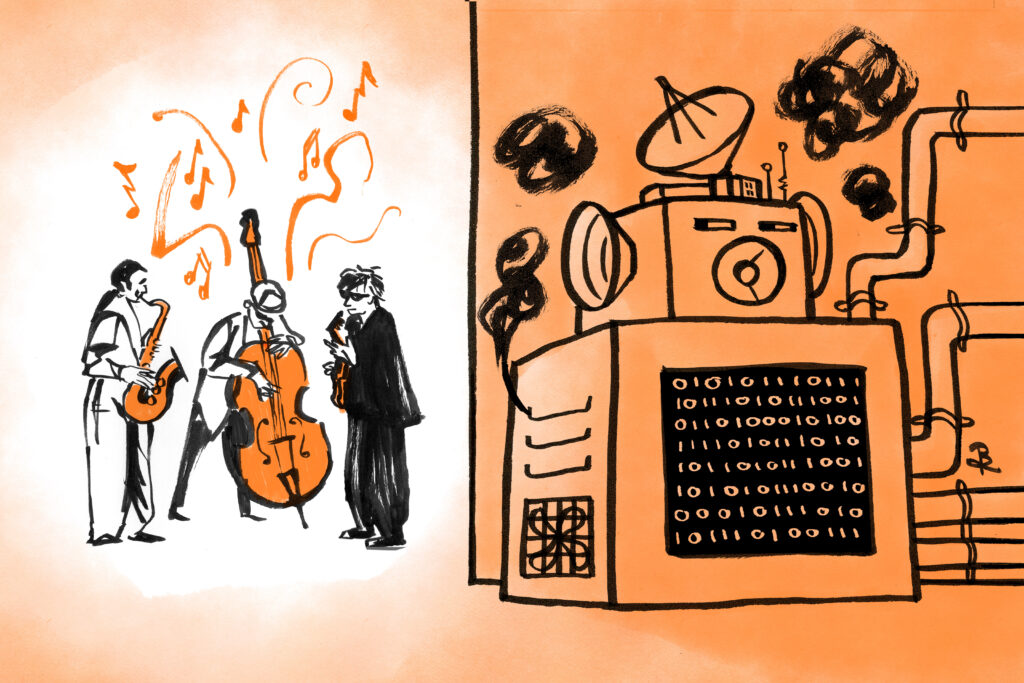
Mikey Shulman, CEO and co-founder of the generative AI music company Suno boldly stated in a recent interview “[AI] actually functions very similarly to how humans do”.
“I’m absorbing all of the things that I know, all of the music that I heard, all of the culture that I see out there, and I’m finding some way to express it… Like just trying over and over and over again and the right thing comes out and that is like, a beautiful piece of music.”
Synthesizing human experience or as Shulman might have it, data, into something apparently new might make the products of generative AI seem no different than those made by traditional human endeavour, but at a fundamental level what happens in these two creative processes is completely different. To show you why, I need to tell you how we wrote Alligator.
Fall down. Get up. Start again.
We wrote and recorded our new album Sea Views Soft Rains during one of the most tumultuous and stressful times in our lives. In our discombobulated Spring of 2025 we made a shortlist of demos for a potential album. These can be something as simple as a drum loop, or two synths overlaid on each other, to more fleshed out songs with some structure, maybe even with demo vocals. They each carry an individual emotional impression of the circumstance of their making, or to put it in wine terms their own terroir. They’ve usually been recorded over a period spanning years, but only collated once we’ve had a few recent experiments which seem to go in a cohesive direction.
When we made that shortlist of demos I became inspired, some of the tracks only needed words. I resolved to do some writing the very next day. Only words, it seemed so simple, but after listening to the tracks for a few hours and straining to scratch out any words at all I was exhausted and despondent.
I needed a reset so went to take a nap, the human equivalent of turn it off and on again, but I couldn’t sleep. I was frustrated with myself. Just write some damn words, the songs are there! After a half hour I re-emerged, somewhat refreshed. Chris was in the studio where I had left him, and in the short time that I’d been away, he’d started a new song.
It sounded great. I immediately heard something in it and exclaimed “the chorus should do a big rising major thirds type thing!” I’m (obviously) not classically trained so I’m lucky that Chris can perfectly understand my pidgin music-speak. He went to the Trigon, I went to the electric piano in the room next door and we searched for the sound I felt. He found it first and quickly worked it into the demo.
Seeds planted in the past
While he tinkered with the instrumentation the track played on a loop. I started writing. The verses spilled out on the page fully formed with melodies floating around my head, it was just missing a chorus. Then I remembered a line from a poem I had written earlier that year. It had been the day after Chris’ birthday in December. I was alone, on my way to the airport, about to fly to Australia to be with my Dad, who had terminal cancer. Chris wasn’t able to be with me. The news had come suddenly. Dad only had a few weeks left and December flights to Australia were prohibitively expensive. At a time when we needed each other most we were forced apart. I wrote this shakily as the train bumped along to Gatwick airport:
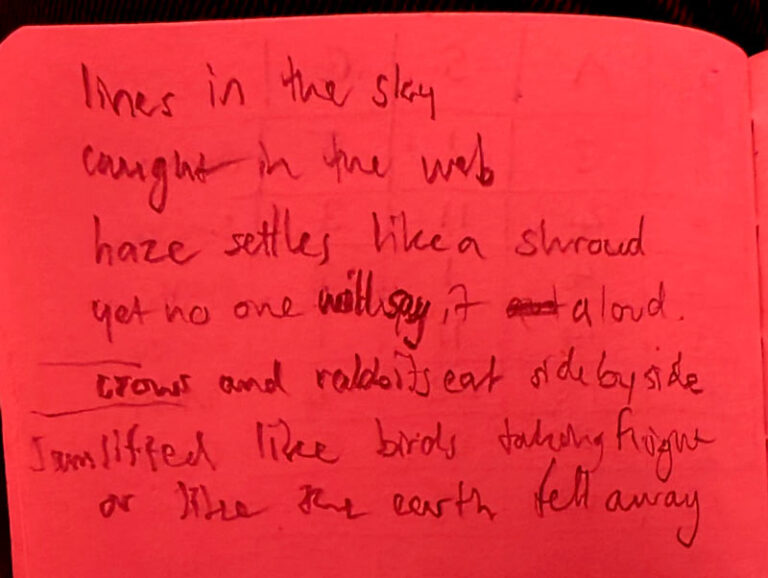
The final lines became the chorus:
Am I flying away
or is the Earth falling down?
Being silly, being uncomfortable, making mistakes.
While I wrote, Chris recorded a demo, faintly at first, slowly pulling words from the air as he went, then louder as it found a form. He’s good at that. We were playing now, having some fun with it. We both started yodelling along with the chorus. Then I was ready to put something down.
We recorded my demo on top of his. I felt naked and unsteady. Chris and I have been married for nearly 14 years but singing demos always comes with a unique feeling of exposure. It’s a weird thing, opening yourself up completely and not knowing what exactly might come out or if it will work. Even Prince, with one of the greatest voices and vocal ranges out there was famously private about recording vocals and would only do it alone or with his trusted engineer.
I had words and some rough melodies but there were parts where I didn’t know what would happen. In those parts I listened, felt the song deeply and let sounds come out without thinking.
It was rough, but it was enough to build on. We listened, Chris piled on some vocal FX and we made notes. By making notes I don’t mean we wrote things down. We talked, sharing ideas moment by moment as the song played on repeat. We both sang along, checking and reinforcing the lines. I asked to record it again, this time with some clarity and confidence. Now we were getting somewhere.
A million tiny decisions
That evening, I had set up a smartphone to film us recording in anticipation of needing ‘content’ for social media when we eventually released the album. I left it on record by accident. Looking back at that footage was weirdly exhausting. Together we made so many tiny decisions in each moment as the song was formed. Listening and playing and singing it over and over again with one tweak after another until we had something we could both call a song.
At one point Chris turned to me and squeezed my shoulder. “What do we have?” “A song?” I offered. “And how did we get it?” He waited, I was confused. “By being in the studio, not going to bed.”
I was fairly indignant and made my excuses. Songwriting requires discipline but it also involves knowing when to quit. If you’re not getting anywhere and you’re heading down a hole it could be time to walk away.
Neil Young agrees. Talking about his process in Songwriters on Songwriting by Paul Zollo, he says “as soon as I start thinking I quit.” However, if he has an idea “day or night, no matter where I am, that takes precedent. That’s the only rule I have.”
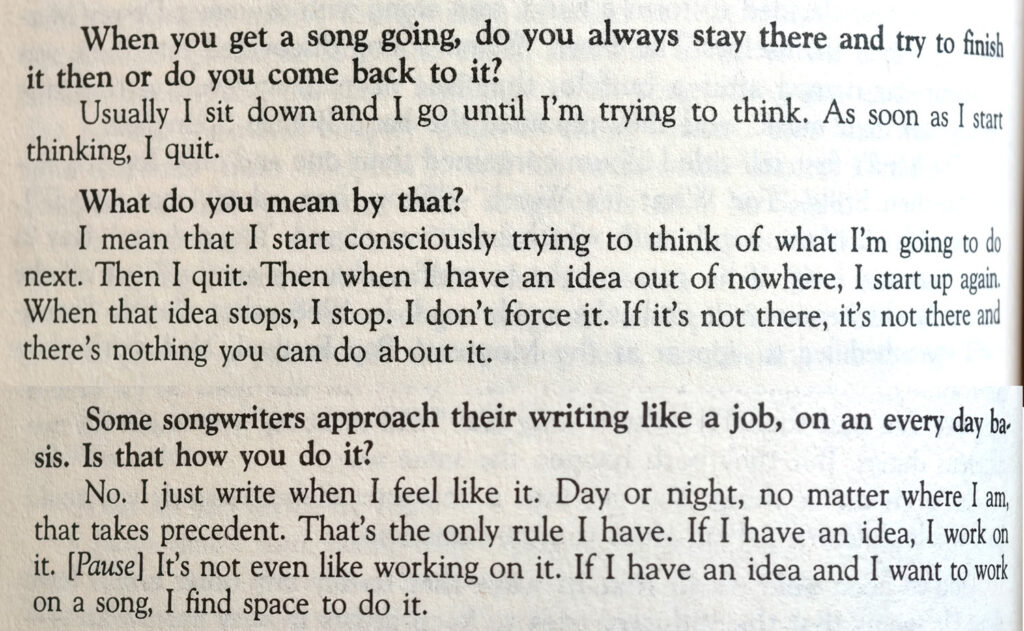
On this day Chris had an idea while I was still stuck in my head, “trying to think”. We’re lucky we were eventually able to get in sync.
Chris and I live together and have a home studio so it’s easier for us to get writing time around our day jobs, but most working class bands don’t have that luxury. It can take time for everyone to align and be in the right place for inspiration to flow. It’s not typical for us to have a full song to come together in one session like this but it’s always pretty special when it does.
It was by no means finished. Chris made a note some months later that the chorus was “making him feel sick”. I suggested cutting out the drums and a lot of the “cutlery” and it went through another transformation to be distilled and improved.
Something AI can’t do
A year later, after further iterations and mastering, it’s finally going out into the world. Watching all the footage we recorded on the night of the session left me with a very strong feeling that this process of creating music is something AI can’t do. The strange mix of sensory perception, communication and divination that is music making is utterly unique.
I predict AI artists will say that the way I work with Chris is the same way they would work with an agent. Bouncing ideas back and forth, refining until it’s formed into what you want, but there is no comparison, for several reasons.
The most obvious is I’m working with a human artist with lived experience and embodied skills. AI artists are prompting results from an aggregate dataset (of stolen IP) which is programmed to deliver a “correct” answer. By their very nature AI agents can only deliver a puréed blend of what has come before, only humans can create something radically new. Hip-hop is a great example of this, and Dr Ethan Hein articulates it perfectly.
“I love 1980s hip-hop because there’s no way to predict it from projecting trends in 1970s pop. It questions basic assumptions! It’s missing elements that you might have thought were necessary (like melodies) and it brings in elements you didn’t know you wanted until you heard them (like samples and turntable scratching.) Now that 1980s rap exists, it’s easy to feed it into an AI as training data and get more 1980s rap, but there’s no way that AI could have produced 1980s rap if it was only trained on 1970s pop.”
Dr Ethan Hein, Adjunct Professor of Music at NYU, AI Slop predates AI
Creativity is a process, not a result
The creative process is labour intensive. It’s emotionally intensive. It usually involves an existential crisis somewhere along the road from idea to result. This nadir of crushing self doubt is an inevitable but important part of the work. Creative people must be brave enough to go there, weather the storm, then navigate their way out of it. A machine has no self-doubt.
“Like the knights of the Middle Ages, there is little the creatively inclined person can do but to prepare himself, body and spirit, for the labor to come — for his adventures are all unknown. In truth, the work itself is the adventure. And no artist could go about this work, or would want to, with less than extraordinary energy and concentration. The extraordinary is what art is about.”
Mary Oliver, Author and Poet, “Of Power and Time,” from Upstream: Selected Essays
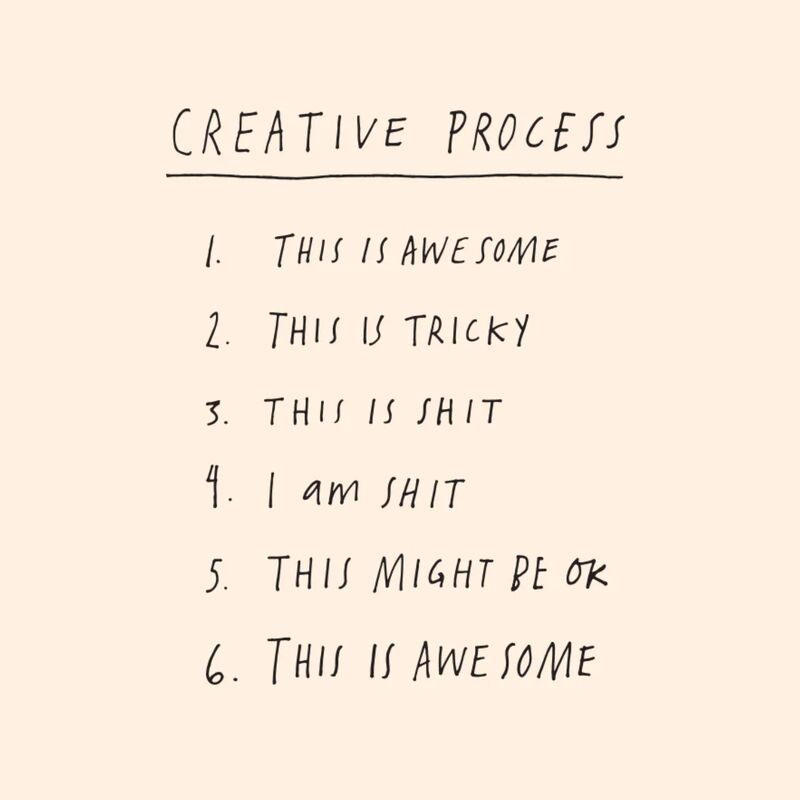
There is an accepted idea of what being in the studio is like. It’s usually portrayed as something like a party. Beats are pounding, the musicians are joyfully and skilfully expressing themselves through their instruments, everyone is nodding at the mix desk and as the engineer pushes the faders into that magic sweet spot a hit is born. Making music isn’t necessarily like that. It’s messy. There are bad times in the studio too. The people making AI music seem to be performing the idea of making music, not the actual process.
The creative process doesn’t need to be optimised
Composer Autumn Rowe expressed her puzzlement at the idea of speeding up production with Suno in a recent article from The Hollywood Reporter:
“I don’t know where the idea came from that this needs to move faster. The CEO of Suno can say people don’t like learning instruments or people don’t like the process of making music, but why is the music being made if it doesn’t come from a place of understanding or liking the process?”
Illustrator Christoph Niemann spoke to the same point in the New York Times recently:
“Communicating emotions from person to person through writing, composing or painting is inefficient and inherently human. Automating the creation of art is like automating life, so you can make it to the finish line faster.”
Making art involves making mistakes, but AI wants to give you the right answer. When you prompt and you get the wrong thing it’s not the same as when you make something and it’s the wrong thing. You learn nothing. When a prompt fails there is no real creative obstacle to overcome, you just get better at prompting to get the result you want.
The difference and the cost
Art comes from a thousand tiny decisions, mistakes and experiments coming together to make something unforgettable. The accumulation of these decisions over a lifetime creates skills and originality that can’t be copied by a machine. Whatever we create, our vision and embodied experience shapes our work.
It could be argued that a human working with an AI agent is bringing discernment and process to the machine’s output to make meaningful work. In my personal experience I’ve seen very few examples of this kind of partnership working effectively. When it does work it tends to be very heavy on the human creation/decision-making side and very light on the genAI side. By contrast there is an ocean of slop flooding our culture and diluting human art, and in music, a lot of it is pure streaming fraud.
Deezer revealed in April of this year that AI-generated tracks now represent 44% of all new uploaded music (75,000 tracks per day), which they detect and remove from the platform. The site sloptracker.org reports that a 2025 estimate found that 28% of new uploads on Spotify were AI-generated. This means that AI music actively diminishes the royalty pool for real human artists.
UMG’s chief digital officer Michael Nash said in March this year that “most of this content is AI slop or fraud fodder”.
“The aggregate organic consumption of AI content by actual consumers is less than half of 1 percent.”
Michael Nash, Chief Digital Officer Universal Music Group, Source: Music Ally
People don’t seem to want AI music. In fact Deezer commissioned a survey by Ipsos in November 2025 in which 97% of respondents couldn’t tell the difference between fully AI-generated music and human-made music in a blind test, yet 80% agreed that 100% AI-generated music should be clearly labeled to listeners and 52% felt that 100% AI-generated songs should not be included in charts alongside human-made songs.
I’ve reported on BOOcast on the various genAI number ones that have hit the news. They’re like novelty songs, news items in and of themselves, often driven to the top by algorithms wired to push a pro-AI story. To me, this music doesn’t sound good. It doesn’t move me.
When I hear real music that resonates the ineffable through my very being in a way no other artform can, I want to know; How did it enter the world? Why does it sound this way? What was its creator feeling at the time? What were the chance events, mistakes and circumstances that led to its improbable eruption into existence? These are questions a human artist can answer fully and deeply. But what would the prompter say?
Humans prompting AI agents to generate music are doing something completely different to traditional musicians. To some, it may have value, but personally, I’m loathe to call it art.
Addendum:
You can hear the final version of Alligator in our band-made music video below. We’ve also created handmade CDs for the new album Sea Views Soft Rains which are available to pre-order now on Bandcamp.
Thank you for supporting independent music. 🙏✨