
We were pretty sick of the news when we wrote Clown. This was back in 2011 when we still had a TV. The news anchors’ incantations grated on us like a distant car alarm. When the weather turned slightly bad, we would laugh as they all repeated the same ominous catchphrase: “widespread disruption”.
Those repeated catchphrases are a symptom of the wider problem with the news, which, once noticed, is impossible to unsee. The major broadcasters are all reading from the same script, and that script has a simple purpose: to distract you and to make you afraid.
The life support machine
That keeps you asleep
The food that makes you hungry
The prize for being weak
— Except from the lyrics for Clown
We weren’t the first to notice this we won’t be be the last, but that period felt a bit like peak TV news. It was just before people started shifting from getting their news on broadcast television, radio and newspapers to getting it from their smartphones. In fact in 2009/2010 Charlie Brooker (Black Mirror) was running a news review show called Newswipe, exposing the ridiculous hysteria it would impose and taking apart it’s format.
“When I tune into the news I often feel like I’ve wandered into episode 389 of the world’s most complex soap opera.”
— Charlie Brooker
Making Clown
In 2011 we moved house, which brought two important changes in our life; 1. We now had a studio (spare bedroom) in which to make music and 2. We got rid of our TV.
We first released Clown on the four-track EP Observatory, so named after our new studio space with it’s Velux ceiling windows, perfect for stargazing. Soon after, we released our debut album Incomplete Until Broken which includes a remastered version of the song. We also gave it a music video.
The music video for Clown makes use of various news title sequences. US news titles especially, with their focus on the glamorous anchors, are designed to be almost comforting, like you’re seeing old friends. Beautiful, smart friends who you can trust. The glitz and the rictus smiles of these anchors feel intrinsically sinister, like a pushy car salesman handing you the pen to sign away your savings. But amongst these flashing masks was an unexpectedly genuine moment of humanity. Brian Travers.
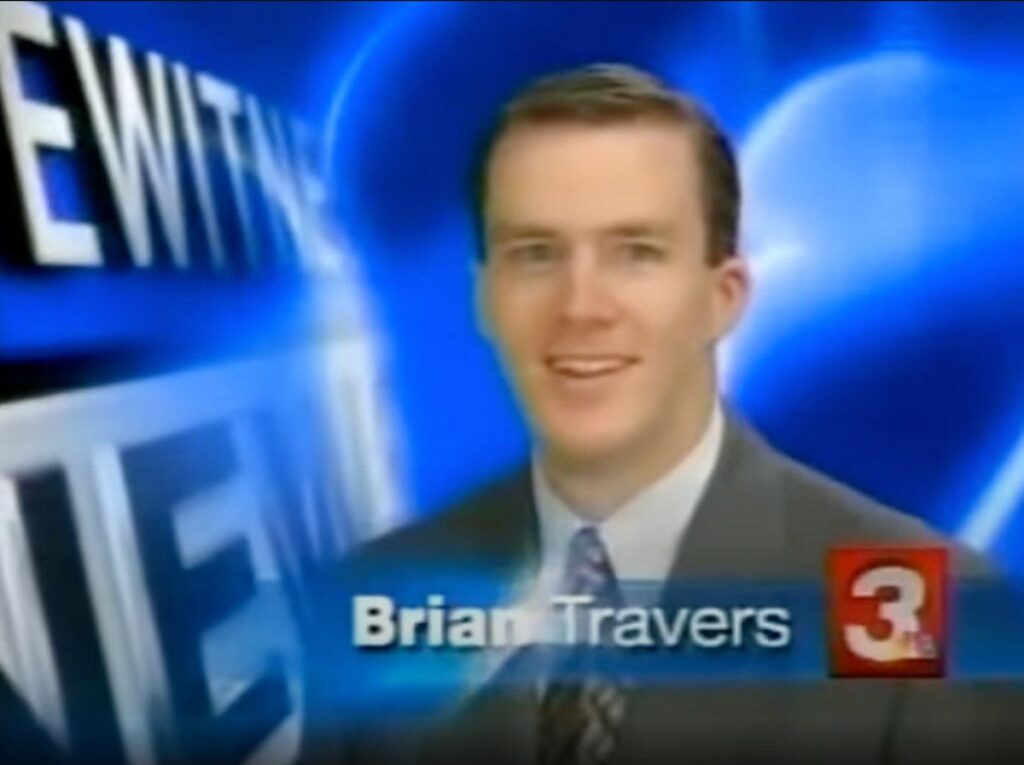
Brian’s guileless smile radiated an honest friendliness which lacked the slick practice of the other newsreaders’ confident grins. He just seemed happy to be there and we liked that. Every time we watched the video we would cheer when he appeared.
After one such cheer I determined to find out more about this man. Who was he? Why was he so different from the others? I needed to know more about him as a person. I needed to see that we were right, he was a wonderful human being. It didn’t take long for me to find him, because in 2002, he was suspected of murder.
“Channel 3 weatherman Brian Travers was the last person known to have seen TV reporter Jennifer Servo before she was found bludgeoned to death, the report said.”
I couldn’t believe it. Not Brian, no way. But as I read on, the story revealed a more complex picture, so I’ll share it with you here.
Who was Jennifer Servo?
Jennifer Servo was an up-and-coming anchor on KRBC news, based in Abilene, Texas. Brian, then 23 years old, was the weatherman there and they became good friends. When interviewed, he said they were briefly intimate, but that she “told me that she just wanted to just be close friends.”
When Brian met Jennifer, she had just come out of a difficult relationship. She had recently moved from Montana to Abilene to work at KRBC, and she’d brought Ralph Sepulveda with her.
Ralph, a former Army ranger, met Jennifer when her first long-term relationship had come to an end. He represented something different from her last boyfriend, something edgier. “Ralph was more the bad boy, wild child, charming guy,” said her best friend Dara Riordan. He was 34 and she was 22.
Once in Abilene, Jennifer discovered that Ralph had a fiancee when they met, whom he left when he started seeing Jennifer. She also found out he had a child whom he never saw. “That was pretty much a deal-breaker for her,” said her sister, Christa.
Jennifer Servo told her colleague and friend Jennifer Loren something else she didn’t like about Ralph. “He had wanted to choke her while they were having sex.”
Three weeks into their life together in Abilene, Jennifer kicked Ralph out. He moved to another apartment complex in Abilene and found a job while Jennifer settled into her new life at KRBC news.
“I think we’re being followed”
After reading the news on Sept. 15, 2002, Jennifer drove with Brian to pick up a coffee table from a friend and do some late night shopping at Wal-mart. During the trip, Jennifer told Brian she thought they were being followed.
“She’s like, ‘I’m pretty sure, Brian. That’s the same car.’ And I was like, ‘You’re just imagining things,'” he said.
When Jennifer dropped Brian at his apartment he offered to walk her to her car. She declined, but he insisted. It was the last time anyone saw her alive.
After two days of being unable to reach Jennifer, KRBC’s news director called the manager of her apartment block to check on her. She was found bludgeoned and strangled to death. There was no murder weapon and no sign of forced entry.
The Investigation
Lead Detective Jeff Bell of the Abilene Police Department, looked first to Ralph and Brian. “Those two guys were the ones who we knew had a personal relationship with Jennifer.” Their reactions to the news of her death were completely different. According to Bell, Sepulveda was very controlled and never asked how Servo had been murdered. “He was not emotional in any form or fashion, just didn’t ask the right questions,” said Bell. “’Jennifer’s dead,’ and he’s like, ‘Oh, that sucks.’ He never asked, ‘How did she die, what happened to her,’ never asked for the details that you would expect someone to ask.” Travers, by contrast, was distraught.
Brian Travers hired a lawyer almost immediately and cooperated fully with the police, even against the advice of his own lawyers. Ralph Sepulveda initially cooperated with police, but just weeks later ceased contact with them, moved out of town and re-enlisted in the U.S. Army for active duty.
Police didn’t rule out the possibility of a stalker. According to colleague Jennifer Loren, Servo had shown her an article about newscasters being stalked just the week before her death.
Police say that Travers has not been completely excluded, but that he has “moved down a little bit on the list of potentials in this case, just because of the cooperation level and everything that we’ve gone through the investigation and checking into him.”
Brian Travers agreed to be interviewed by “Primetime,” and denies any role in Jennifer Servo’s death. Jennifer Loren quickly agreed. “He’s like our sweet, adorable, couldn’t-hurt-a-fly, Brian. There’s no way.”
Sepulveda wouldn’t talk to “Primetime,” and more importantly for Jennifer Servos’ mother Sherry Abel, he didn’t show up for the memorial service which was attended by more than 300 people. She said, “there were no condolences, phone calls, a card and no Ralph at that ceremony.”
Sepulveda remained the primary person of interest in the case, and five years after the murder, police traveled to Seattle to question him yet again, but couldn’t bring any new evidence to light. The case has remained cold since.
But then, while editing this article I discovered that just this year, the Abilene Police Department sought help from the television show, “Cold Justice,” to hopefully resolve the case.
Resolution at last?
“Cold Justice” brought the necessary budget to fund the Abilene Police Department’s cold case team in reviving the investigation, flying Abilene detectives to Montana to interview Servo’s family, to Tennessee to interview former suspect Brian Travers and lastly to Hawaii to interview Sepulveda.
Detective Jeff Cowan from the cold case unit said that while Brian Travers is “a little bit awkward socially,” he has no previous criminal record, has shown willingness to help the case at every step and has maintained ties with Servo’s family. Detectives in the show requested to speak to Travers in person, and against the advice of his own lawyers he did. While he declined to appear on camera, it seems he satisfied all of the detectives’ questions.
Cowan gave the final word, saying, “He’s cleared in all this.”
The investigation brought to light new evidence including entries in Jennifer Servo’s diary detailing her relationship with Ralph, including one in which she stated, “He’s mooching off me!” Upon reviewing the timeline of their relationship, show host and prosecutor Kelly Siegler said, “This is an obsession. This isn’t just love.”
In reviewing Jennifer’s neighbour’s original statement about the night of the murder, detectives noted that the neighbour woke up at 2 a.m. and heard “two people were yelling at each other,” adding, “it sounded like a two-way conversation.”
This key witness testimony meant that the assailant was likely known to Servo. She wouldn’t have let a stranger into her house.
“Based on what we have, all roads lead back to Ralph,” Detective Cowan said. Siegler concluded at the end of the show that, “Detectives Jeff Cowan and Shawn Montgomery are going to present their case to their prosecutor seeking charges for the murder of Jennifer Servo against Ralph Sepulveda.”
Servo’s mother Sherry Abel said, “I finally feel we are going to have some justice for Jen.”
News you can trust
It’s thanks to the excellent local reporting at The Chattanoogan and Abilene Reporter News that I’ve been able to share this story with you. People need news, but we news we can trust. Any media company saying “trust me” needs to be looked at with some skepticism.
The news outlets realise that trust is low. In 2018, nearly 200 news anchors read the same script warning people about fake news, and implicitly to trust their own news station as a source for truth.
“Unfortunately, some members of the media use their platforms to push their own personal bias and agenda to control exactly what people think. And this is extremely dangerous to our democracy.”
These stations are all owned by Sinclair Broadcast Group. Scott Livingston, senior vice president of news for the company stated in The Baltimore Sun “We are focused on fact-based reporting. That’s our commitment to our communities. That’s the goal of these announcements: to reiterate our commitment to reporting facts in a pursuit of truth.”
People once believed in the news without needing such assurances. TV stations and newspapers were seen as bastions of truth, but Chris Morris’ satirical recasting of news as entertainment in Brass Eye and The Day Today became reality decades ago. The news became an addictive yet comforting clown show with it’s 24hr cycle alternating between more terrifying reasons not to leave the house today and the soothing panacea of sport and weather.
It doesn’t mean there’s no truth in news at all, it just means we have to work harder to find it. Strip back the layers of vested interests behind each story, find arguments and perspectives from all sides. When a story isn’t just informative, but emotionally charged, ask why. Why do they want me to be angry, or afraid? Why is this clown dancing and shouting and waving their arms at me?
And when the clown says “trust me”? Don’t listen to the clown.
Watch the video for Clown by Battery Operated Orchestra below.