
Our song and music video for Always On verges on the horrific. While on the surface it’s about social media, it comes from a lot of different places. The journey of it’s creation takes us from dolls becoming human to social experiments on mice and ultimately the consequences of switching it all off. This is part two of two. Read part one here.
It’s always on. That thing is always on.
The music for our track Always On was born when Chris wrote some audacious synth brass lines that came together in a spiky demo with some doodled lyrics dispersed over it. I quickly tuned into the feeling of it and we bounced the lyrics back and forth between us until we got them right.
Constant stream
You’ve got eyes to feed
Give ‘em what they need
‘till your fingers bleed
— excerpt from the lyrics for Always On
We followed a similar process with the edits for the music video. Soon after we got the track completed Chris was inspired to start making some visuals for it. He pulled clips from Tik Tok and Instagram, ramped and changed the colours and cut them together really quickly. I added some clips to the mix, Chris refined the edit, and it became more and more nightmarish, to the point that we felt it was too much (we eventually released this edit as the lyric video). We needed to give it some breathing space and context.
Chris then envisioned the sinister cube and the test subject who would slowly become distorted and enveloped by its oozing black horror. The final component was the mice.
The Beautiful Ones
In the music video we made reference to American ethologist John Calhoun’s experiments in overpopulation in rodent colonies. He created utopias for rats and mice in order to study their behaviour when the population grew. He made 24 such utopias, each experiment ending prematurely due to lack of space, until his landmark study: Universe 25.
Universe 25 was designed to be a paradise for mice. A huge enclosure with numerous private nesting areas, abundant nesting supplies and unlimited food and water. Into this rodent’s Garden of Eden he placed four female and four male mice.
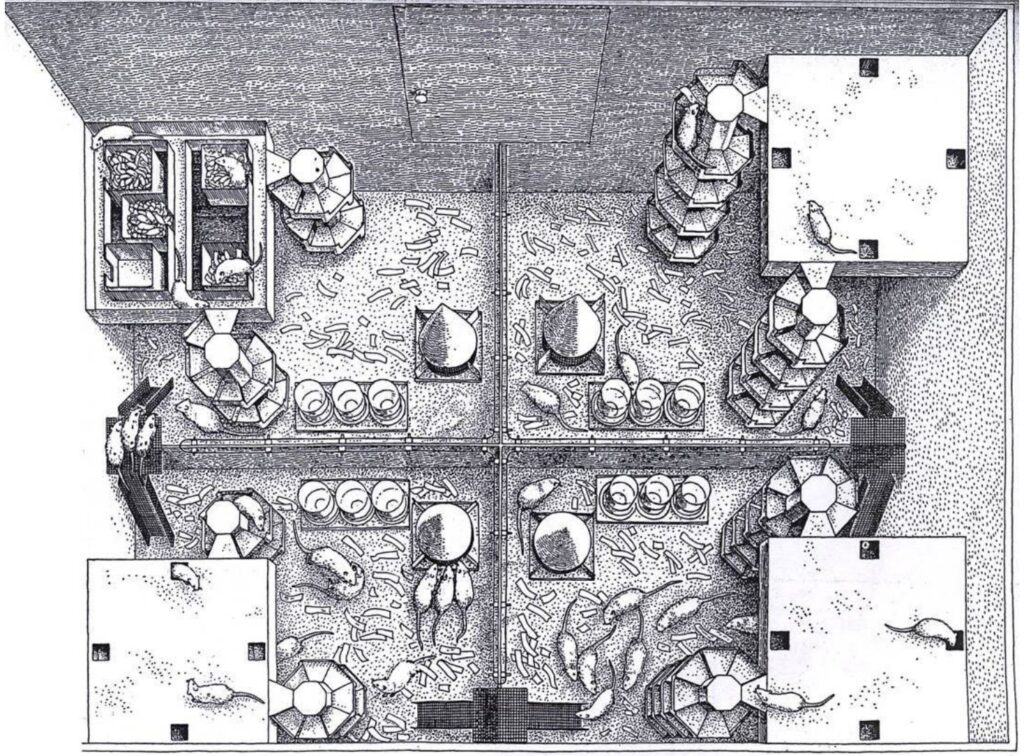
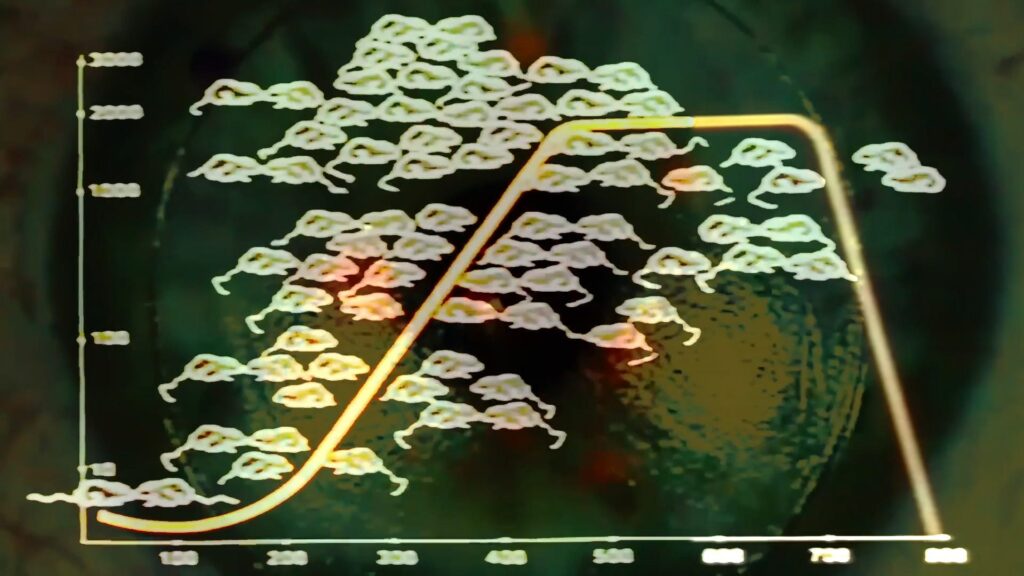
The mice multiplied and all seemed well, but around a year into the experiment the population hit 600 and growth slowed. The mice were living in a world that was becoming increasingly crowded.
Males found it difficult to defend their territory so they eventually gave up trying. Instead of interacting with their peers they would gather in a large, listless group in the middle of the enclosure and occasionally break into fights. The mice who were attacked would remain relatively immobile during a vicious mauling, having lost the capacity to flee. These mice would then go on to attack others.
The group Calhoun termed “the beautiful ones,” were male mice who weren’t interested in mating and scrupulously avoided conflict to focus on grooming. While the mice around them were scarred and wounded from multiple fights, these mice were oddly pristine-looking. They just ate, slept, and preened, disengaged from the increasingly nightmarish world around them.
Nursing females, now having to defend their own nests against invaders, would become aggressive, even attacking their own young or abandoning them altogether. The mice pups born into this world were neglected and unable to form social bonds or engage in complex social behaviours. They didn’t know how to be mice anymore. Even when removed from Universe 25 and introduced to “normal” mice they couldn’t learn how to behave. Calhoun said that they had already died—a “first death”, a death of the spirit, before the “second death” of their physical body.
After about 1800 days of Calhoun’s Universe 25 experiment, the last mouse died, surrounded by all the space, food and water it could have needed to survive.
Moral decay from excessive social interaction
People have drawn comparisons between Calhoun’s experiments and the collapse of Western civilisation. It’s easy to observe the parallels, but scientifically speaking Calhoun’s experiment was on mice, not humans, and the two aren’t interchangeable.
In the mid-1970s, psychologist Jonathan Freedman recruited high school and university students to carry out his own experiments on behaviour and population density. In 1975 he declared to have found no statistically significant negative effects from population density and psychologists tended to agree. Medical historian Dr. Edmund Ramsden declared in a 2008 interview with the NIH Record that “Rats may suffer from crowding; human beings can cope.”
However, Freedman suggested that moral decay resulted not from population density, but from excessive social interaction. He argued that striking the right balance between privacy and community would reduce social pathology. He believed that it was the unwanted, unavoidable social interaction that drove even social creatures mad.
Get exclusive music releases and behind-the-scenes content by subscribing on Bandcamp as a BOOster. It’s the best way you can support what we do.
Is there any way out of this maze?
In 2025 these pernicious platforms still seem to be necessary to our livelihood as musicians. We post nearly every day and it’s definitely helping us grow our audience, but I’m exploring alternatives.
After ten years as a band we’ve found that the most powerful way to get our music heard is not necessarily by shouting into the crowded room that is social media, it’s through connecting directly with people. In-person at shows, on our livestream BOOcast and via our mailing list.
I think the biggest thing we give that can help [artists] is the ability to email your audience and create your own mailing list [off platform]… Particularly going back to social media and the frailty of that, building an email list is just so important… Those are your fans, they’re not ours.
— Bandcamp’s European Artist and Label Representative Aly Gillani being interviewed by Declan McGlynn at Future Filter
Beyond our own efforts to forge these connections, the most powerful force we have to reach more people are our existing fans. I cannot understate the importance of one person sharing our music with someone else who might like it. These direct connections carry much more weight and meaning than a like on social media.
There is a balance to be struck between life online and in the real world. We can prioritize the real world and when we do interact online we should do so mindfully, in ways that give us meaningful connections rather than feeding us distraction.
We can live a life without social media in its current, damaging form. It starts when we cut out the interfaces getting between us and connect directly with each other.
Watch the video for Always On by Battery Operated Orchestra below.